

Descrizione
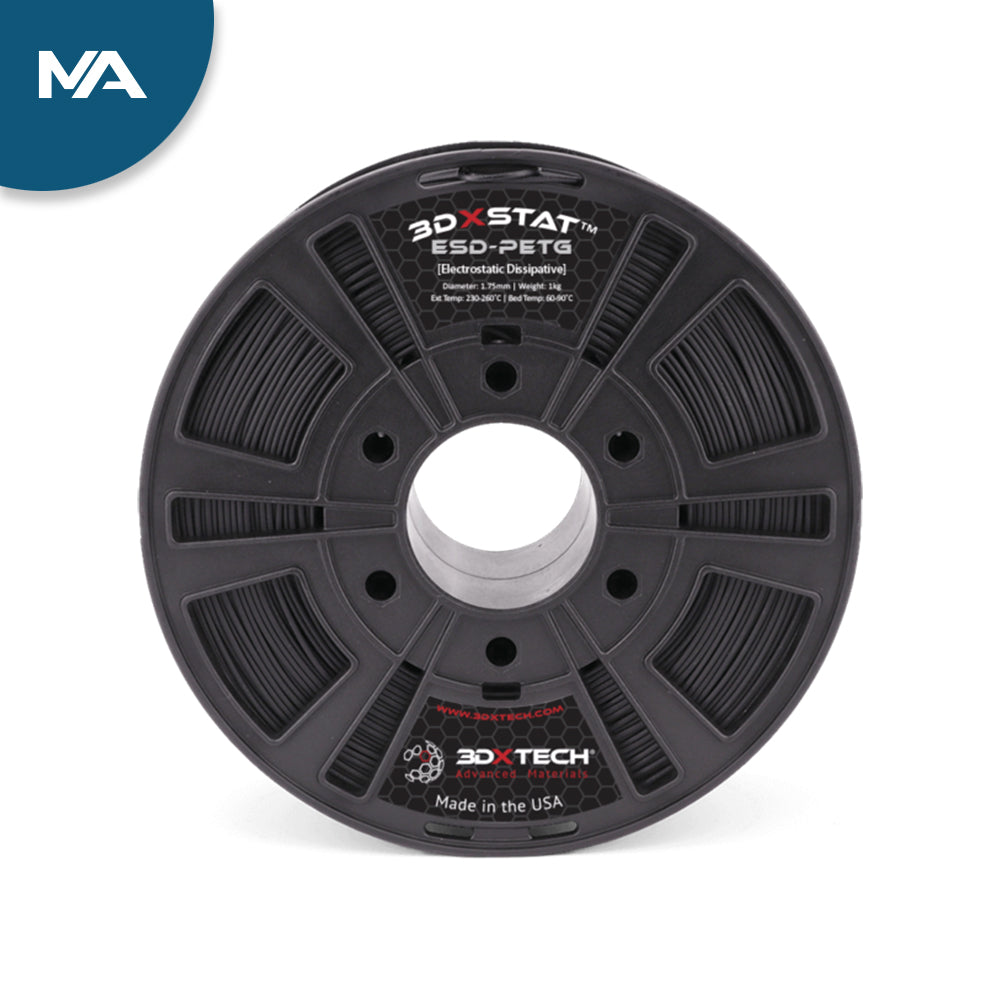
3DXSTAT™ ESD-PETG is an easy-to-use ESD-safe filament formulated for a wide range of applications requiring electrostatic discharge (ESD) protection and enhanced chemical resistance. Made using a high-flux PETG and CNT copolymer for exceptional repeatability and reliability.
Made using cutting-edge multi-walled carbon nanotube technology, cutting-edge compounding technology, and precision extrusion processes. Target surface resistance: 10^7 to 10^9 Ohms. A
The advantages of PETG include:
- Superior chemical resistance compared to ABS
- Amorphous structure that gives low, nearly isotropic shrinkage
- Low moisture absorption, 3 times lower than ABS
- Very low odor emitted during printing
- Superior ductility compared to ABS
- Wide working range of 230-260°C
The benefits of 3DXSTAT™ include:
- Constant surface resistivity
- Better impact retention and stretch
- Low particulate contamination
- Minimal contribution to outgassing and ionic contamination
Typical ESD PETG applications include:
Semiconductor: HDD components, wafer handling, masks, enclosures and connectors
Industrial: transportation, measurement and sensing applications
Target Conductivity for 3DXSTAT ESD-PETG:
Surface resistivity from 10^7 to 10^9 ohms on 3DP sample using the concentric ring test method.
Note: Internal studies have shown that increasing extruder temperatures can achieve higher conductivity levels. Similarly, lower extruder temperatures have resulted in lower conductivity levels. Each printer is configured differently, as are part geometries. Therefore, expect some trial and error to determine how this filament performs in your specific printer/application. However, do not exceed 270°C to reduce the risk of polymer degradation.
Surface conductivity as a function of extruder temperature:
The surface resistance of an ESD-protected part varies depending on the printer's extruder temperature. For example, if tests indicate that the part is too insulating, increasing the extruder temperature will result in better conductivity. Therefore, the surface resistance can be "dialed in" by adjusting the extruder temperature up or down depending on the reading you receive from your part.
Recommended print settings:
- Extruder: 230-260°C
- Bed temperature: 60-90°C
- Bed Prep: Magigoo Bed Prep Adhesive and 3DXTECH Polyimide Tape work best for us.
- Heated room: not required
- Supports: Water-soluble AquaTek X1 USM works great for complex parts.
- Drying instructions: 65°C for 4 hours.