

Descrizione
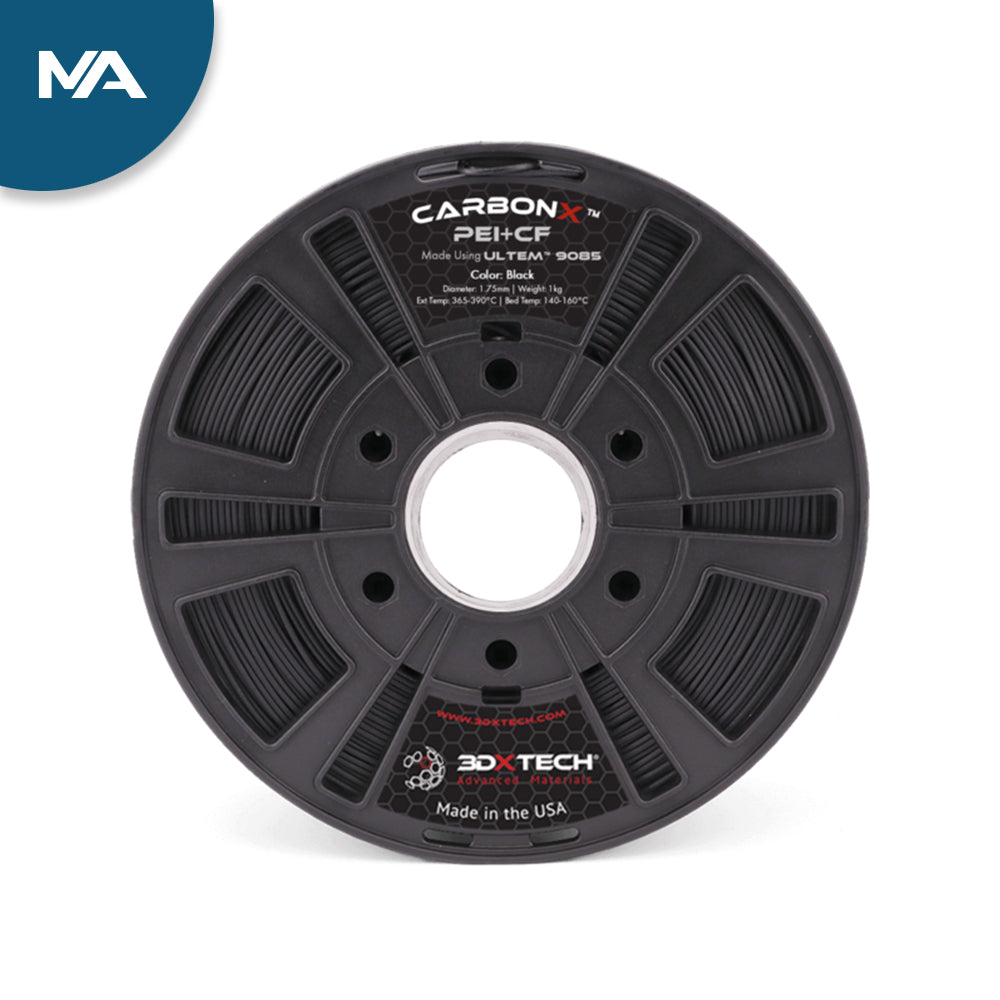
CarbonX™ PEI + CF [Aerospace] is made using Sabic Ultem™ 9085 PEI (polyether imide) and Toray Torayca™ T800 aerospace-grade carbon fiber. Toray's T800 aerospace-grade carbon fiber offers excellent strength and stiffness and pairs excellently with Ultem™ 9085, creating an exceptional material with excellent flammability, thermal, mechanical, and chemical resistance.
CarbonX™ CF PEI 9085 Aerospace is made using Sabic Ultem™ 9085 resin and 10% certified Toray T800 chopped carbon fiber. This custom formulation is a premium aerospace-grade print material specifically formulated for our aerospace customers.
Ultem™ 9085 is FAA approved for Flame/Smoke/Toxicity (FST) applications and meets FAR 25.853 and OSU 65/65 standards. Toray T800 carbon fiber has a diameter of 5 µm (compared to 7 µm for standard carbon fiber), allowing for more fibers per cc3 of material than standard carbon fiber. This allows for superior strength and stiffness while maintaining excellent dimensional stability and printability.
The advantages of Ultem™ PEI+CF:
- High thermal properties, Tg of 186°C and HDT of 165°C
- Inherent flame resistance thanks to Ultem™ 9085 base resin
- Improved stiffness and strength for structural applications
- Excellent dimensional stability: lower CTE, warpage and shrinkage than unfilled grades
- Resistance to a wide range of chemicals, including automotive fluids, fully halogenated hydrocarbons, alcohols and aqueous solutions
Typical applications of PEI+CF Ultem 9085:
Aerospace:
ULTEM PEI+CF's excellent balance of flame retardancy, low smoke emission, and low smoke toxicity makes it an excellent candidate for aerospace and aviation applications. ULTEM offers low toxicity, smoke, and flame development. Ultem resins are found in applications such as personal service units, oxygen panels and components, ventilation system components, connectors, cable trays, latches, hinges, food tray containers, door handles, and interior trim parts.
Automotive and transportation sector:
PEI+CF resins provide automotive manufacturers with a high-performance, chemically resistant, thermally stable, and cost-effective metal alternative that is strong enough to replace steel in some applications but lightweight enough to replace aluminum in others. These resins are used in applications such as transmission components, throttle bodies, ignition components, sensors, and thermostat housings.
Electronics:
PEI+CF can be an excellent material choice for today's demanding electrical applications, including connectors, MCB components such as housings, shafts and levers, hard disk drive internals, FOUP, BiTS, PCBs, MCCB internals, Plenum devices, LCD projector internals, fuel cell components and many other applications.
Recommended print settings:
- Extruder: 365-390°C
- Bed temperature: 140-160°C
- Bed preparation: Nanopolymer adhesive, 3DXTECH polyimide tape or Ultem PEI tape give us the best results
- Other: No cooling fan with 16mm/s print speed as a starting point
- Heated chamber: Recommended, a chamber helps reduce warpage and improves layer adhesion, up to 180°C if present
- Supports: ThermaX HTS High-Temp Support is ideal for complex, high-temperature materials like this one.
- Drying instructions: 140°C for 4 hours.
ULTEM™ is a registered trademark of Sabic Innovative Plastics
Abrasive material
This material is particularly abrasive among 3D printing filaments. Users may find that standard brass nozzles wear out very quickly compared to standard nozzles. If worn, the nozzle diameter will expand inconsistently, and the printer will experience extrusion issues.
Use hardened steel nozzles with this filament to maximize head life and the quality of your prints!
For this reason, it is highly recommended to print this material through a hardened steel nozzle rather than a softer metal. Hardened steel nozzles are often inexpensive and easily installed, depending on the printer manufacturer's instructions.