
Descrizione
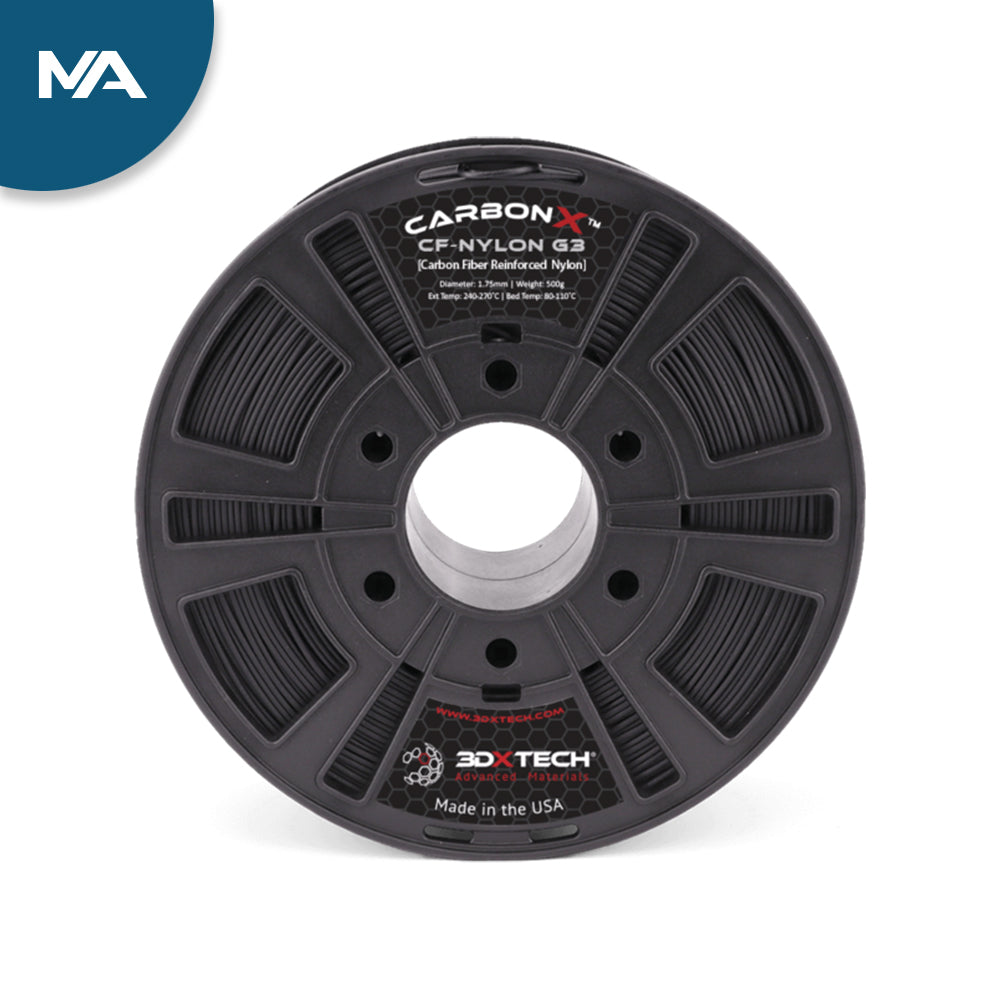
CarbonX™ PA6+CF [Gen3] is made using a special Nylon 6 [PA6] copolymer and high modulus carbon fiber. This is the ideal material for industrial applications that require superior thermal, mechanical, and chemical resistance while maintaining the ease of printing you expect.
Gen 3 CarbonX™ PA6+CF filament is formulated using a high-modulus carbon fiber-reinforced PA6 copolymer. This filament is ideal for anyone looking for a structural part with high modulus, improved chemical and thermal resistance, excellent surface quality, and ease of printing. Gen3 has a higher HDT than our previous grades (147°C at 0.45 MPa), allowing for extended use in higher-temperature applications.
Unmatched stiffness gives designers the properties they need to make their 3D printed parts with less material and save weight without sacrificing stiffness.
The advantages of Nylon PA6+CF:
- Excellent printability
- High tensile strength and stiffness
- Resistance to abrasion and wear
- Better chemical resistance than traditional 3D printing materials
- High thermal properties
Recommended print settings:
- Extruder: 240-270°C
- Bed temperature: 80-110°C
- Nozzle: We currently recommend a hardened steel nozzle with a minimum diameter of 0.4mm
- Note: The ideal layer height is 60% of the nozzle diameter. It's recommended not to print layers smaller than 0.2 mm with carbon fiber-reinforced filaments.
- Bed Prep: Magigoo Bed Prep Adhesive Gives Us the Best Results
- Heated chamber: Not required, but a heated chamber between 30 and 80°C allows for superior bonding and superior mechanical properties
- Supports: Water-soluble AquaTek X1 USM works great for complex parts.
- Drying instructions: 90°C for 4 hours.
Abrasive material
This material is particularly abrasive among 3D printing filaments. Users may find that standard brass nozzles wear out very quickly compared to standard nozzles. If worn, the nozzle diameter will expand inconsistently, and the printer will experience extrusion issues.
Use hardened steel nozzles with this filament to maximize head life and the quality of your prints!
For this reason, it is highly recommended to print this material through a hardened steel nozzle rather than a softer metal. Hardened steel nozzles are often inexpensive and easily installed, depending on the printer manufacturer's instructions.